2026 Top Medical Tube Types How to Choose for Procedures

Time:2026-10-17 Author:Sophia
0%

Medical tubes are small components with major clinical consequences. Their inner diameter, flexibility, material, and connector design can affect flow, comfort, sterility, and procedure time. A feeding tube must pass smoothly through a narrow route. An endotracheal tube must maintain an airway without causing unnecessary tissue pressure. These are different engineering problems.

The World Health Organization’s Global Report on Infection Prevention and Control states that healthcare-associated infections affect about 7 in 100 acute-care patients in high-income countries. The proportion can reach 15 in 100 in low- and middle-income countries. Tube selection cannot ignore contamination risks, packaging integrity, or handling practices. It also requires attention to clinical purpose, patient anatomy, exposure time, and disposal requirements.

Market research from Grand View Research and MarketsandMarkets describes continued growth in medical tubing demand, supported by minimally invasive procedures, diagnostic devices, and single-use systems. However, market growth does not make every tube suitable. That assumption can fail.

This guide explains How to choose medical tubes for different procedures through practical clinical and technical criteria. It compares common types, including silicone, PVC, polyurethane, PTFE, and specialty multilayer tubing. Material compatibility matters. So does visibility.

A clear tube may help clinicians observe fluid movement, while radiopaque markings can support placement checks. A stiff tube may improve insertion control but increase discomfort. A softer tube may improve comfort but collapse under negative pressure. These trade-offs require professional judgment, validated specifications, and supplier quality evidence. ISO 10993 biocompatibility principles, relevant ISO 13485 quality systems, and applicable regulatory requirements should guide final decisions. No selection chart replaces clinical assessment. Mistakes remain possible. Recheck the details.
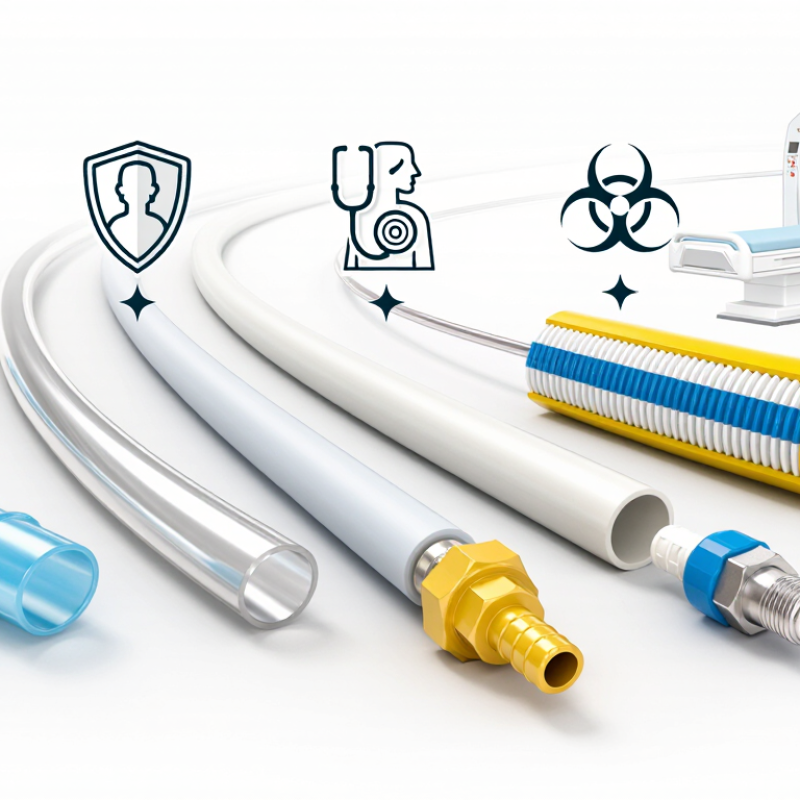
2026 Top Medical Tube Types How to Choose for Procedures

Define Procedure Needs: ID, OD, Pressure, Flow, and Sterility Targets

Choosing a medical tube starts with the procedure, not the catalog description. Define the required inner diameter first. A narrow ID may restrict flow or increase resistance. A wider ID can improve delivery but may reduce flexibility. Measure the outer diameter too. It must fit the access site, connector, clamp, or instrument channel without stressing surrounding tissue.

Pressure and flow targets need real operating data. Record peak pressure, working pressure, fluid viscosity, temperature, and expected duration. A tube rated for average pressure may fail during sudden surges. Use pressure testing with the exact connectors and bends. Flow should be checked under realistic conditions, not only with water at room temperature. Small bends can change performance. That detail is easy to miss.

Sterility requirements should match the complete procedure. Specify whether the tube is sterile, supplied in a sterile barrier, or intended for validated processing. Confirm material compatibility with the chosen sterilization cycle, medication, contrast fluid, and biological exposure. Review extractables, leakage, particulate control, and lot traceability. Documentation matters as much as the tube. I would also challenge every assumption. Medical grade alone does not prove suitability. Neither does a familiar size. A short trial may reveal kinking, poor visibility, or awkward handling before clinical use. Some requirements remain uncertain until the full assembly is tested.

Compare Top Tube Materials: PVC, Silicone, TPU, PTFE, and Polyolefin

In 2026, medical tube selection depends on the procedure, not popularity. PVC remains cost-effective, clear, and easy to process. It suits short-term fluid delivery when controlled flexibility is acceptable. Its plasticizer system requires careful extractables and leachables evaluation.

Silicone feels soft and performs well across changing temperatures. It is useful when patient comfort and flexibility matter. However, it can tear more easily and allows greater gas permeability. TPU offers strong abrasion resistance, elasticity, and kink control. It works well in moving assemblies, but formulation and sterilization can affect long-term performance.

PTFE provides very low friction and strong chemical resistance. Its stiffness may complicate routing around tight anatomical paths. Polyolefin tubes are lightweight and often show low extractables. Polyethylene and polypropylene grades differ greatly in flexibility, clarity, and stress-crack resistance. Material choice should also consider pressure, wall thickness, fluid compatibility, sterilization cycles, and required shelf life. Small details matter. During development, I would test the actual tube with the actual fluid, temperature, and connectors. A material that looks ideal on paper may fail during bending, sealing, or repeated handling. One common oversight is judging softness by touch alone. I prefer documented testing, traceable specifications, and verification against applicable medical-device requirements before production use.

Screen Biocompatibility with ISO 10993, USP Class VI, and Extractables Data

Medical tubing selection should begin with biocompatibility evidence, not appearance or price. ISO 10993-1 recommends a risk-based evaluation linked to contact type, duration, and body tissue. A tube touching blood needs a different assessment from one carrying a topical solution. Review material composition, sterilization exposure, temperature, and flow conditions.

USP Class VI testing can support material screening, but it is not a complete clinical safety decision. It mainly evaluates biological reactivity under specified tests. Extractables data adds sharper detail. USP <1663> and <1664> describe controlled studies for identifying chemical substances released during use. PDA Technical Report No. 66 also supports a structured extractables and leachables program. Look for GC-MS, LC-MS, and ICP-MS results, with reporting limits and toxicological evaluations. Numbers matter.

A practical review should compare simulated-use data with real procedure conditions. For example, warm saline, repeated pumping, and gamma sterilization may reveal compounds missed by basic testing. I have seen teams accept a USP Class VI result too quickly. That shortcut is risky. No single certificate proves universal compatibility. ISO 10993-18 chemical characterization, exposure estimates, and toxicological review should connect the evidence. The weak point is often incomplete supplier data. Ask for test methods, sample history, and unexplained peaks. A clean table can still hide uncertainty. That uncertainty deserves documentation.

2026 Top Medical Tube Types: How to Choose for Procedures — Screen Biocompatibility with ISO 10993, USP Class VI, and Extractables Data

Tube Type / Typical Material Common Procedure Applications Key Performance Characteristics Typical Patient-Contact Consideration ISO 10993 Screening Focus USP Class VI Relevance Extractables and Leachables to Review Selection Guidance
Silicone tubing
Medical-grade silicone elastomer
Drainage, respiratory circuits, feeding, infusion, peristaltic-pump tubing, and short- or long-term catheter components Highly flexible, good temperature range, strong kink resistance, transparent or translucent grades, generally suitable for steam sterilization when specifically validated External, mucosal, blood-path, or implant-contacting use depends on formulation, cure system, surface treatment, and finished-device validation ISO 10993-5 cytotoxicity; ISO 10993-10 or current applicable irritation and sensitization endpoints; ISO 10993-11 systemic toxicity; ISO 10993-18 chemical characterization when risk assessment requires it Often available for medical silicone, but Class VI is a material-level screening result and does not replace device-specific ISO 10993 evaluation Low-molecular-weight siloxanes, catalyst residues, pigments, processing aids, and cure by-products; request solvent-specific extractables data Choose when flexibility, biostability, and broad temperature performance are more important than high pressure or abrasion resistance
Polyvinyl chloride tubing
Flexible PVC, usually plasticized
Blood and solution administration sets, drainage, suction, respiratory and enteral applications Cost-effective, clear, weldable, available in many hardness levels, and compatible with common connectors; plasticizer selection strongly affects performance Contact duration and fluid type are critical; blood-contacting and neonatal applications require careful review of formulation and additive migration ISO 10993-5, irritation and sensitization endpoints, hemocompatibility where applicable, and chemical characterization under ISO 10993-18; toxicological assessment may follow ISO 10993-17 Some formulations have USP Class VI data, but the result must match the exact resin, plasticizer, colorant, and processing history Plasticizers, stabilizers, lubricants, residual monomers, pigments, and sterilization-related degradation products; evaluate aqueous, polar-organic, and non-polar extraction conditions as relevant Select for economical fluid transfer and reliable solvent bonding, but control extractables, plasticizer migration, and sterilization effects
Polyurethane tubing
Thermoplastic polyurethane, TPU
Vascular catheters, infusion lines, minimally invasive devices, drainage, and high-flexibility delivery systems High flexibility, abrasion resistance, good tensile strength, and potential for thin-wall construction; grades differ in hydrolysis and oxidation resistance Blood-contacting or prolonged-contact use requires formulation-specific hemocompatibility and degradation assessment ISO 10993-5, sensitization and irritation endpoints, hemocompatibility for blood contact, ISO 10993-13 or -14 degradation assessment when applicable, and chemical characterization May be available for selected grades; verify the exact hard-segment chemistry, additives, colorants, and sterilization condition Chain extenders, catalysts, antioxidants, colorants, residual solvents, oligomers, and hydrolysis or oxidation products A strong option where flexibility and toughness are needed; confirm long-term aging, moisture exposure, and sterilization compatibility
Thermoplastic elastomer tubing
TPE or styrenic-block formulations
Disposable fluid paths, pump tubing, respiratory accessories, enteral sets, and non-implantable procedural assemblies Soft touch, weldability, scalable processing, and a wide hardness range; compression set and chemical resistance vary considerably by formulation Usually selected for limited-duration contact unless long-term stability and biological performance are specifically demonstrated ISO 10993-5, irritation, sensitization, systemic toxicity where justified, and ISO 10993-18 chemical characterization are commonly considered Class VI status is formulation-specific and should not be inferred from the generic TPE family name Hydrocarbon process oils, tackifiers, antioxidants, colorants, oligomers, and residual processing chemicals Use when soft handling and heat-sealing are important; obtain a full additive disclosure and targeted extractables profile
Fluoropolymer tubing
PTFE, FEP, or PFA
High-purity fluid transfer, laboratory and diagnostic systems, chemical delivery, and low-friction catheter components Excellent chemical resistance, low friction, and low surface energy; PTFE is relatively stiff, while FEP and PFA offer melt-processable alternatives Patient-contact suitability depends on the exact grade, additives, processing, surface condition, and intended contact duration ISO 10993-5 and chemical characterization are typically relevant; evaluate particulate, surface residue, and hemocompatibility risks for blood-contacting designs Class VI documentation may exist for specific grades, but fluoropolymer family identity alone is not sufficient evidence Residual processing aids, pigments, inorganic fillers, surfactants, and fluorinated low-molecular-weight species; require method sensitivity appropriate to the risk Prefer for chemical inertness and low friction; avoid assuming flexibility or bonding performance without design-specific testing
Polyethylene tubing
LDPE, HDPE, or specialized PE grades
Single-use fluid transfer, irrigation, feeding, drainage, and packaging-integrated delivery paths Low moisture absorption, good chemical resistance, lightweight construction, and a broad stiffness range; heat resistance is lower than that of PEEK or many fluoropolymers Often used for external, mucosal, or short-duration contact; prolonged or blood-contacting applications require exact-grade validation ISO 10993-5 and chemical characterization; assess particulate and mechanical degradation risks for implanted or invasive use Confirm Class VI results for the precise grade, additives, colorant, and manufacturing process Antioxidants, slip agents, mold-release residues, pigments, oligomers, and processing contaminants A practical choice for low-moisture-uptake fluid paths; confirm flexibility, weldability, and sterilization method before selection
Polypropylene tubing
PP homopolymer or copolymer
Containers, rigid or semi-flexible fluid paths, diagnostic systems, irrigation, and sterilizable procedural components Low density, good chemical resistance, low moisture absorption, and relatively high heat resistance; can become brittle depending on temperature and formulation Commonly considered for short-duration contact; long-term and implant-related use requires device-specific biological and aging data ISO 10993-5, irritation and sensitization as applicable, chemical characterization, and particulate assessment for invasive applications Verify exact resin and additive package; Class VI data does not cover every PP formulation Antioxidants, nucleating agents, slip agents, pigments, residual monomers, and processing residues Choose where chemical resistance and moderate heat resistance are needed, while checking impact strength and bend-radius requirements
PEEK tubing
Polyether ether ketone
High-performance catheter components, analytical and diagnostic fluid paths, surgical instruments, and demanding reusable or sterilizable assemblies High strength, dimensional stability, chemical resistance, fatigue resistance, and high-temperature capability; more rigid and costly than common flexible polymers Suitable only when the exact medical grade and finished-device configuration support the intended contact category and duration ISO 10993-5, irritation and sensitization, systemic toxicity where justified, chemical characterization, and particulate or wear evaluation for moving interfaces Material-level Class VI evidence may be available for selected grades; verify processing history and any fillers or radiopaque additives Trace oligomers, pigments, fillers, processing residues, and wear particles; use thermal and chemical extraction conditions relevant to the application Select for demanding temperature, strength, and chemical-resistance requirements rather than softness or low-cost disposable use
Glass tubing
Borosilicate or other medical-use glass
Rigid diagnostic channels, cartridges, syringes, analytical systems, and high-purity fluid-contact assemblies Excellent dimensional stability, transparency, chemical resistance, and low organic extractables; brittle and unsuitable where flexibility or impact resistance is required Contact suitability depends on glass composition, surface treatment, breakage risk, and the complete assembled device Chemical characterization, cytotoxicity where relevant, particulate risk, and biological evaluation of coatings, adhesives, seals, and other contacting components USP Class VI is generally more relevant to polymeric components; do not use it as the sole qualification route for glass assemblies Inorganic ions, surface-treatment residues, coating components, adhesive residues, and particles from abrasion or breakage Prefer for rigid, high-purity, low-organic-extractables applications where brittleness can be controlled
Important qualification note: ISO 10993 evaluation and USP <88> Class VI testing are not interchangeable. Biological safety depends on the finished tube or device, manufacturing process, sterilization method, surface treatment, contact type, and contact duration. Request current material specifications, formulation or additive disclosures, lot information, sterilization validation, and extractables data generated with application-relevant solvents, temperatures, surface-area-to-volume ratios, and analytical methods such as GC-MS, LC-MS, and ICP-MS.

Verify Safety Standards: ISO 80369, ISO 8536, ISO 10555, and ISO 11070

Choosing medical tubes in 2026 requires more than checking diameter, flexibility, or price. Connector safety deserves equal attention. The WHO 2023 Patient Safety Fact Sheet reports that one in ten patients experiences harm during healthcare, with more than half considered preventable. A small mismatch can create serious clinical risk. ISO 80369 addresses small-bore connectors and helps prevent misconnections between incompatible applications. Confirm the relevant subtype, such as enteral or neuraxial use. Do not treat “ISO compliant” as a complete explanation.

ISO 8536 covers infusion equipment, including sets and related components. ISO 10555 applies to sterile, single-use intravascular catheters. ISO 11070 covers accessories used during intravascular catheterization, including guidewires and introducer components. These standards are connected, but not interchangeable. Request the exact standard edition, test scope, material details, sterilization method, and lot traceability. Check leak, tensile, pressure, and dimensional results where applicable. ISO itself does not certify products. An external certificate may cover only one model or connector. That detail is easy to miss. I would also compare the manufacturer’s technical file with actual samples, because paperwork can look complete while a fit feels unexpectedly tight. National adoption and clinical-use requirements may differ, so procurement teams should verify current regulatory guidance before approval.

2026 Top Medical Tube Types: How to Choose for Procedures

Verify the applicable safety framework before selecting tubing, connectors, infusion sets, or intravascular catheter accessories.

The chart compares the publication years of selected ISO standards commonly relevant to medical tube systems and procedure-specific accessories. ISO 80369 addresses small-bore connectors, ISO 8536 covers infusion equipment, ISO 10555 covers intravascular catheters, and ISO 11070 covers accessories for intravascular catheters. Always confirm the current edition, product classification, sterilization requirements, and procedure-specific compatibility before use.

Select Tubes for Infusion, Drainage, Respiratory, and Surgical Procedures

In 2026, medical tube selection should begin with the procedure, not the catalog. Infusion tubes need accurate flow control, secure connections, and materials compatible with the prescribed solution. Check the inner diameter, flexibility, kink resistance, and connector design. Small differences can affect delivery accuracy.

Drainage tubes require careful attention to fluid thickness, expected volume, and tissue sensitivity. A wider lumen may reduce blockage, but it can increase discomfort or trauma. For respiratory procedures, assess gas flow, cuff performance, visibility, and patient anatomy. The tube should remain stable during movement. It should not create unnecessary airway pressure. Clinical guidelines and local regulations must support the final choice.

Surgical tubes often face blood, irrigation fluids, suction forces, and repeated handling. Smooth surfaces can reduce tissue irritation, while clear materials help staff observe fluid movement. Sterility, packaging integrity, and traceability also matter. I have seen teams focus heavily on size and overlook connector security. That mistake deserves more attention. Tube selection is not perfectly predictable. Patient condition, operator technique, and procedure length can change performance. Experienced clinicians should reassess the tube during use, document unexpected resistance, and replace it when safety becomes uncertain.

FAQS

How should medical tubing selection begin?

Begin with the procedure, contact type, and expected use duration. Price and appearance are not enough. Review composition, sterilization, temperature, and flow conditions.

What does ISO 10993-1 help evaluate?

It supports a risk-based biocompatibility assessment. The evaluation should match contact with blood, tissue, skin, or solutions. Duration also matters.

Does USP Class VI prove complete clinical safety?

No. It mainly indicates biological reactivity under defined tests. It does not prove universal compatibility. That shortcut can be risky.

Why is extractables data important?

Extractables studies identify chemicals released under controlled conditions. Look for exposure estimates and toxicological evaluations. Numbers matter.

Which laboratory results should a supplier provide?

Request GC-MS, LC-MS, and ICP-MS results when appropriate. Check reporting limits, test methods, and sample history. Unexplained peaks need review.

How should simulated-use testing reflect real procedures?

Compare testing with actual temperature, fluids, pumping, and sterilization conditions. Warm saline and repeated pumping may reveal missed compounds. Basic testing can be incomplete.

What features matter for infusion and drainage tubes?

Infusion tubes need stable flow, secure connections, and solution compatibility. Drainage tubes need suitable lumen size and blockage resistance. A wider lumen may increase discomfort.

What should teams assess during respiratory and surgical procedures?

Check gas flow, cuff performance, visibility, tissue sensitivity, and stability. For surgery, also review suction forces, sterility, packaging, and traceability. Conditions can change. Document unexpected resistance and reassess the tube.

Conclusion

Choosing the right tubing is essential for safe and effective medical procedures. How to choose medical tubes for different procedures begins with defining the application’s requirements, including internal diameter, outer diameter, pressure tolerance, flow rate, flexibility, and sterility targets. The procedure environment and contact duration should also guide the selection.

Common materials such as PVC, silicone, TPU, PTFE, and polyolefin offer different balances of flexibility, strength, chemical resistance, transparency, and temperature performance. Material choices should be supported by biocompatibility evaluations, including ISO 10993 testing, USP Class VI information, and extractables data. Before final approval, verify that the tube and its connectors meet relevant safety requirements, including ISO 80369, ISO 8536, ISO 10555, and ISO 11070 where applicable. Infusion, drainage, respiratory, and surgical procedures each demand tailored tubing characteristics, so performance testing, sterilization compatibility, and reliable quality documentation should be reviewed together before use.

Sophia

Sophia

Sophia is a dedicated marketing professional with an exceptional depth of knowledge about her company's products and services. With a keen understanding of market trends and customer needs, she crafts insightful blog posts that not only inform but also engage readers, enriching the company’s online......